What are automated lead follow-ups?
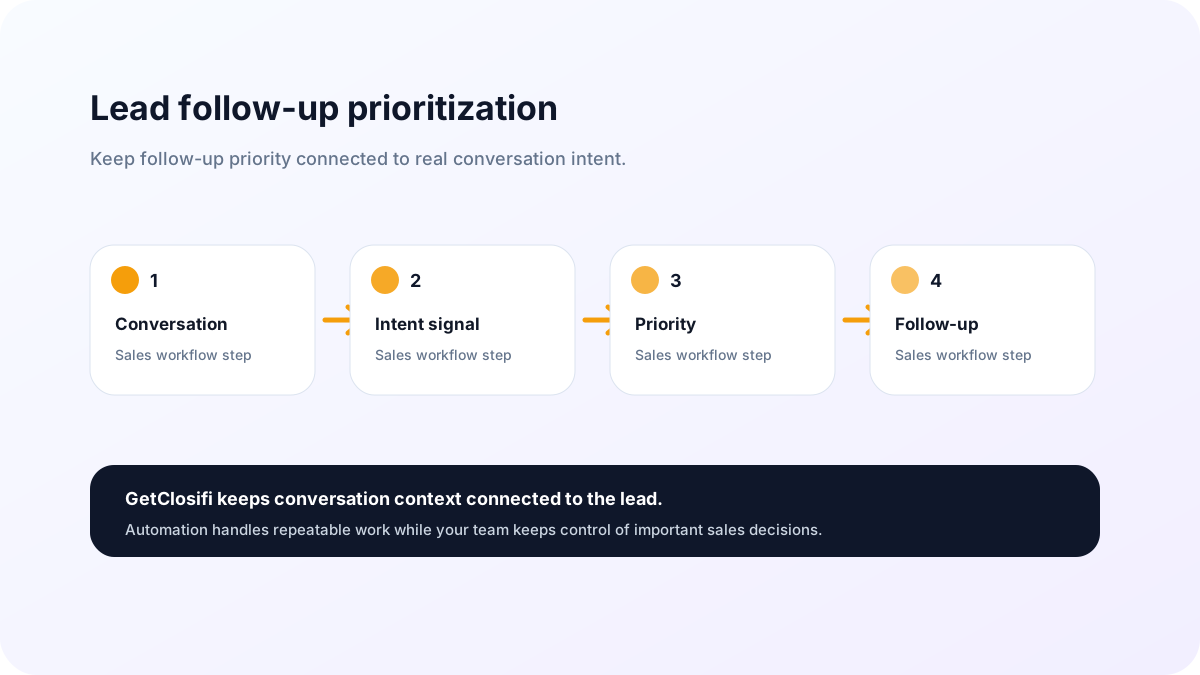
Automated lead follow-ups help a sales team remember and prioritize the next action after the first customer conversation. The goal is not to send the same reminder to every prospect. A useful follow-up system keeps the conversation context attached to the lead and looks for signals that show when a person is ready for another step.
Those signals may include a customer asking for a demo, sharing a budget, requesting a quotation, giving a preferred meeting time or replying after a period of silence. By organizing those moments, GetClosifi helps the team focus on leads that have a meaningful reason to be contacted again.
Why good leads are lost without a follow-up process
Many sales opportunities do not close during the first chat. A prospect may need time to compare options, speak with a partner, wait for approval or simply return later. If the business relies on memory, promising conversations can disappear underneath newer messages.
A structured follow-up process makes the next action visible. Instead of asking the salesperson to remember every conversation, the system keeps lead status, recent activity and qualification context together so the team can decide who needs attention now.
How GetClosifi prioritizes follow-ups
Follow-up priority should change as the conversation changes. A newly contacted lead with no clear intent should not always rank above a qualified prospect who just requested a demo. GetClosifi can use lead stage, qualification score and conversation signals to surface stronger opportunities first.
- Qualified: the lead has enough context to show a meaningful fit or buying intent.
- Proposal: the conversation has reached a demo, meeting, quotation or similar next step.
- Explicit next action: the customer asks for a call, reply, appointment, pricing follow-up or more details.
- New activity: a recent message can change the priority of a lead that previously looked cold.
Better rule: follow up because the conversation created a reason to act, not simply because the lead exists in the database.
A practical lead follow-up workflow
- A customer starts a conversation through Instagram, WhatsApp or another connected channel.
- The AI sales agent captures useful context such as requirement, budget, timeline and contact details.
- The lead moves to the appropriate stage as buying intent becomes clearer.
- When a next-step signal appears, the lead is surfaced in the follow-up queue.
- Your team continues from the previous conversation with context already available.
Connect follow-ups with your full sales workflow
Lead follow-ups are strongest when they are connected to the channels where conversations actually happen. GetClosifi combines follow-up context with Instagram DM automation, WhatsApp automation and an AI sales agent. The Business Copilot can then help the owner understand which opportunities deserve attention across the wider pipeline.
Lead follow-up FAQ
Should every new lead receive the same follow-up?
No. Different leads have different intent and context. A demo request, proposal discussion or clear buying signal usually deserves more attention than a generic enquiry with no next step.
Can follow-up priority change after a new message?
Yes. A new customer reply can create a stronger next action, so the follow-up queue should update as the conversation changes.
Does automated follow-up mean AI sends every message?
No. Automation can help surface priorities and support repeatable steps while the business keeps human control over important sales conversations.
What an automated lead follow-up system should prioritize
A useful follow-up system should not treat every open lead as equally urgent. GetClosifi can use lead stage, recent conversation context and explicit next-step signals such as a demo, meeting or quote request to surface the opportunities that need attention.
This works best when follow-up starts with a good first response and qualification process. See AI lead response automation for the earlier part of that journey.