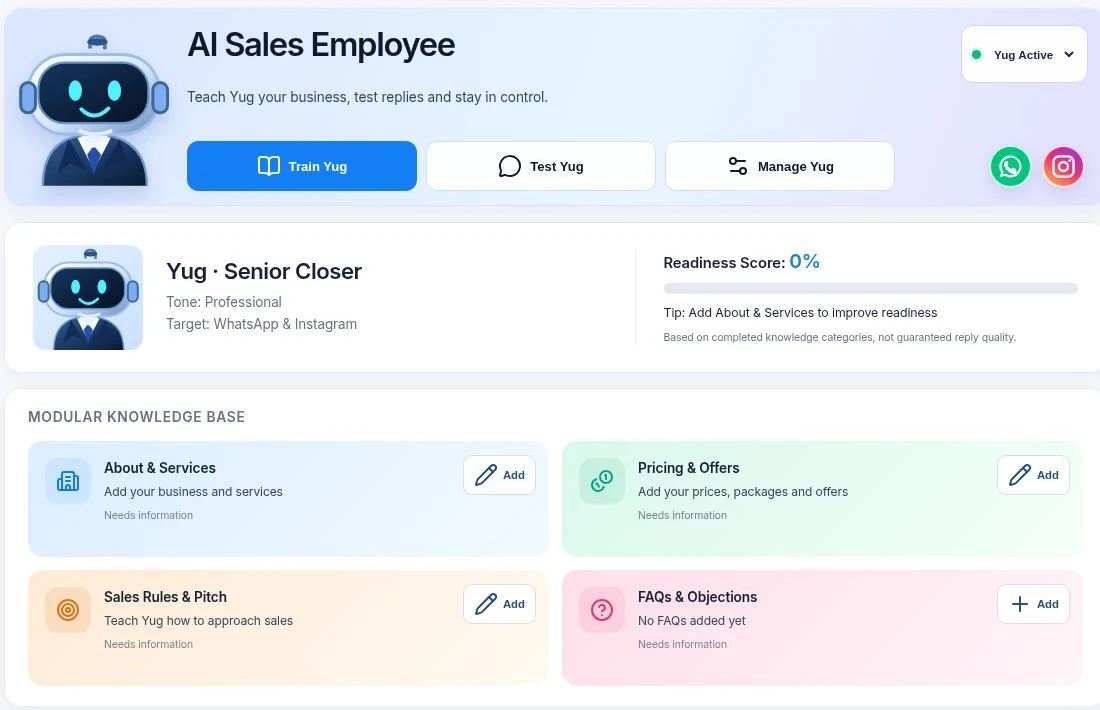
Build an inbound AI SDR playbook in seven practical steps
An AI SDR for inbound sales is not an automatic prospect-list scraper or a cold-email machine. Its job is to understand people who already enquired, record genuine buying intent and give your salesperson a useful next action.
Follow these steps in order
Define the ideal customer and the wrong-fit customer
Write down who you sell to: location, business size, budget band, service use case and minimum requirements. Also define clear exclusions. An agency selling ₹30,000/month campaign management, for example, should not classify every 'social media help' enquiry as a fit without knowing the client's goal and realistic budget.
What to check: The sales team has a short fit checklist, including at least one reason to say 'not a fit'.
List the four facts needed for your next sales step
For an inbound agency enquiry these might be current channel, monthly ad spend, desired outcome and launch timeline. For real estate they could be location, budget, unit type and visit readiness. Collect only what changes a sales decision; do not demand an email when a verified conversation channel already allows human follow-up.
What to check: A lead can be summarized in four lines without forcing the prospect through a form.
Teach Yug approved answers and boundaries
Prepare clear descriptions of packages, inclusions, typical process, geographic scope and who confirms custom pricing. If a question requires specialist input, define the escalation. An AI SDR should not invent ROI, promise guaranteed revenue or present rough estimates as signed quotations.
What to check: A test with an unsupported question gets a transparent answer and a human next step.
Start with an answer, not a questionnaire
For a prospect asking 'Do you do Meta Ads for property projects?', first answer whether that service is offered, based on the approved business knowledge. Then ask one question that changes the recommendation: is it lead generation for new projects or resale inventory? That earns permission to explore budget and timing.
What to check: The prospect's original question is addressed before new questions are asked.
Evaluate fit and buying intent separately
Someone can fit your target customer but not be ready to buy today. Another buyer can be ready to buy but outside your service area. Record fit, stated timeline, decision process and requested action separately; don't treat a polished AI-generated confidence score as evidence of a deal.
What to check: A sales rep sees both fit and readiness rather than only a label like 'hot'.
Hand off with ownership and unresolved questions
When the customer requests a quotation, live demo or a specialist, capture their preferred contact channel, what has been answered, the need, and who will respond. If the answer depends on inventory or a contract, keep it unconfirmed until reviewed by a person.
What to check: The human rep knows the next action and does not need to restart qualification.
Review the SDR with a small real-world test set
Try vague enquiries, qualified buyers, poor-fit prospects, changed requirements, pricing exceptions and explicit human requests. Inspect captured facts and actual handoffs. Over time compare enquiry-to-qualified and qualified-to-next-action rates, not merely how many greetings were sent.
What to check: A failed example is traceable to missing business knowledge, bad routing or wrong qualification logic.
Worked example: inbound enquiry for a marketing agency
Illustrative scenario for learning, not a screenshot of a real customer or proof of a measured result.
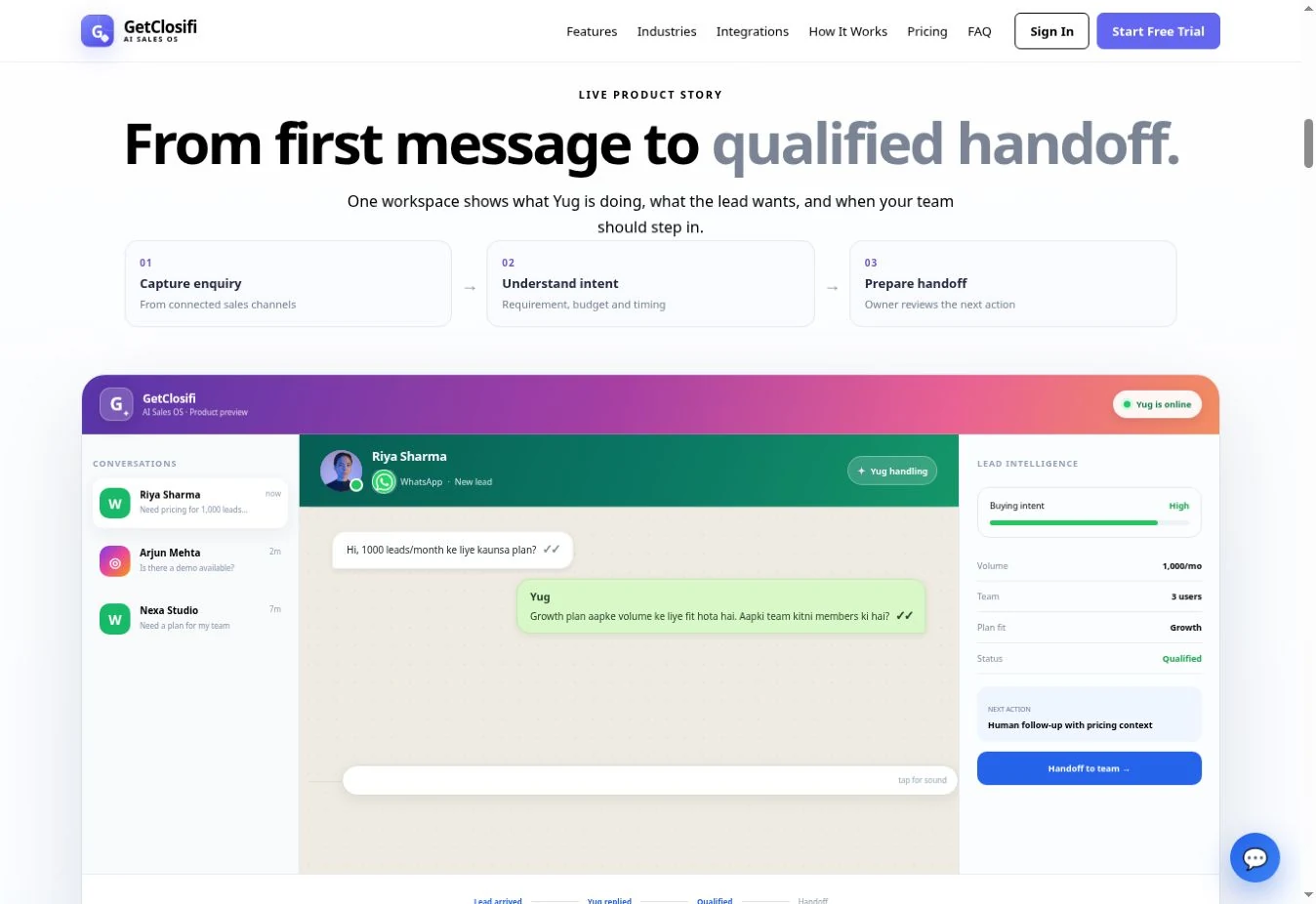
We run a new real estate project. Can your agency handle Instagram leads?
We handle that service if it is listed in our approved offering. Is your main goal project enquiries, site-visit bookings or brand reach?
Site visits. Budget roughly ₹40,000 a month. Launch next month.
Understood: real estate, site visits, approximately ₹40,000/month and next-month launch. Before I pass this to the team, which city is the project in? I'll note any pricing or results discussion as pending human confirmation.
Problems to check before going live
The SDR calls every enquiry qualified
Check the fit rules: defined requirement, a real next action and a reachable prospect matter more than a high AI score.
Salespeople still ask every question again
Improve summaries and visibility of captured requirements; compare the original conversation with the handoff.
Someone expects cold outreach automation
Explain the product boundary: inbound qualification is distinct from automated prospect scraping or outbound campaigns.
Ready to test the workflow with your own business?
Prepare one accurate offer, one representative customer question and one clear human follow-up rule. Compare the actual response and handoff against these steps before paying for ads or migrating customers.
Check GetClosifi plans and current inclusions →What is an AI SDR?
An AI SDR is a software-based sales development assistant that handles early-stage conversations before a human salesperson needs to step in. For inbound sales, that usually means replying to new enquiries, understanding what the prospect wants, asking relevant qualification questions and preparing the next action.
GetClosifi applies this idea to messaging channels such as Instagram and WhatsApp, where buyers often ask short, high-intent questions before they fill out a form or book a call.
AI SDR vs a basic chatbot
A basic chatbot typically follows a fixed menu or answers a small set of predefined questions. An AI SDR is more focused on the sales journey. It should understand the reason for the enquiry, collect useful context and recognize when the conversation is ready for a human.
The goal is not to automate every decision. The goal is to reduce repetitive first-response work while preserving enough context for a salesperson to continue naturally.
What an inbound AI SDR can handle
An inbound AI SDR can respond to pricing questions, clarify requirements, collect contact details, ask about budget or timeline when relevant and identify signals such as demo requests, meeting interest or quote requests.
Those details become more useful when they are connected to AI lead qualification, lead stages and follow-up instead of remaining buried inside a chat transcript.
AI SDR software for small business sales teams
Small teams often lose leads because a new message arrives while everyone is busy. The first response may be delayed, and even after a reply the next action can be forgotten. An AI SDR creates a consistent first layer so the prospect receives attention and the team receives better information.
This is especially useful when many enquiries are repetitive but the final sales conversation still requires human judgment.
Use AI SDR with WhatsApp and Instagram
GetClosifi can combine an AI SDR-style workflow with WhatsApp automation and Instagram DM automation. The customer stays in the channel they already use, while the business gets structured lead context behind the conversation.
For ongoing sales work, connect this with lead follow-ups and the Business Copilot.
When should a human salesperson take over?
A human should take over when the conversation reaches negotiation, custom pricing, complex technical questions, exceptions, sensitive situations or a clear buying decision. The AI SDR should make that handoff easier by preserving what the prospect has already shared.
A good handoff means the salesperson can continue from the current context instead of asking the customer to repeat the same information.
AI SDR FAQ
Can an AI SDR qualify inbound leads?
Yes. It can collect relevant details and buying signals during the conversation so the team can see which leads appear ready for the next step.
Does an AI SDR replace a salesperson?
No. It is best used for repetitive early-stage work, while humans remain responsible for negotiation, exceptions and important commercial decisions.
Can an AI SDR work on WhatsApp and Instagram?
GetClosifi is focused on inbound sales conversations from WhatsApp and Instagram, so the same qualification principles can support both channels.
What should an AI SDR collect?
Only the information your sales process genuinely needs, such as requirement, budget, timeline, contact details and the next requested action.
AI SDR software: inbound qualification vs outbound prospecting
An AI SDR can mean different products. Outbound SDR tools research accounts, build prospect lists and initiate approved outreach. Inbound AI sales agents instead respond after a customer contacts the business and help identify fit, intent and the next step.
GetClosifi focuses on the inbound side: customer conversations on connected WhatsApp, Instagram and website channels, supported by business-provided information and AI lead qualification. It should not be evaluated as an automatic cold-email sender, lead scraper or unrestricted outbound DM tool. For B2B buyers, the practical test is whether the AI captures the decision maker's needs and passes useful context to a real salesperson.
Focused AI qualification or a broader team inbox?
If your team is comparing omnichannel software with an inbound sales assistant, the respond.io alternative guide breaks down channel breadth, team operations and qualification-first sales workflows.