What are the best sales automation tools for 2026?
There is no single best sales automation tool for every team. HubSpot is well-suited to CRM-led workflows and sequences; Pipedrive emphasizes pipeline and activity automation; Zoho CRM and Freshsales serve contact-and-deal workflows; Zapier connects your apps; GetClosifi is designed for AI-assisted inbound sales conversations.
A small agency receiving Instagram leads, a B2B SaaS team using cold email and a property office handling WhatsApp questions do not need identical software. The best choice is the product that removes your biggest repeat task while preserving data visibility, permissions and a clear human owner.
Start with our plain-English sales automation definition and examples if you are new to the subject.
Sales automation tools comparison at a glance
These are product fit suggestions, not rankings by verified sales results. Each provider has different billing units and plan-specific capabilities.
| Software | Best use case to evaluate | Entry pricing context | Check before choosing |
|---|---|---|---|
| HubSpot Sales Hub | CRM workflows, sequences, lead rotation and prospecting | Free CRM foundation; advanced automation depends on Sales Hub tier | Seats, enrolled contacts, sequence and workflow limits |
| Pipedrive | Visual deal pipeline, activity automation and sales follow-ups | 14-day trial; Lite from $14/seat/month billed annually; Growth $39 | Automations may require Growth or higher |
| Zoho CRM | Contact records, lead assignments, reports and CRM automation | Free edition for 3 users; paid tiers for higher needs | Workflow quota and CRM features by plan |
| Freshsales | Lead and account management, tasks and sales activity pipeline | Free for up to 3 users; Growth from $9/user/month, billed annually | Chatbot, advanced automation, phone and AI add-ons |
| Zapier | Connecting lead forms, CRMs, spreadsheets and notifications | Free tier with 100 tasks/month | Task usage and premium app/flow functionality |
| GetClosifi | Inbound WhatsApp, Instagram and website lead conversations | Starter ₹999/month displayed on website; 7-day trial | Channel authorization and human handoff; not a full CRM replacement |
Vendor offers checked on October 20, 2026. Prices can change; tax, add-ons, user count, billing cycle and channel charges affect total cost.
Six sales automation platforms explained
1. HubSpot Sales Hub
HubSpot centers sales automation around its CRM records: workflows, lead routing, tasks and prospecting sequences can keep teams aligned. A business that already uses HubSpot for forms and lead records may find it simpler to automate there instead of adding more tools.
Use case: a new inbound lead matches a sales territory, gets assigned to a representative and enters an approved follow-up sequence. Consider: paid-feature and seat restrictions are significant for advanced workflows. Official HubSpot automation ↗
2. Pipedrive
Pipedrive supports a visual deal pipeline with triggered activities. Salespeople can keep stages, next actions and contacts visible. Its current plan lineup lists Lite and Growth, and the Growth tier offers automations and nurturing sequences.
Use case: moving a qualified deal to a new stage creates the correct task for its owner. Consider: a low-cost entry plan does not imply every automation is included. Official workflow features ↗
3. Zoho CRM
Zoho CRM provides lead and deal records, follow-up tasks, and workflow tools across editions. Its free plan supports three users, which may suit an early-stage business replacing spreadsheets with a central system.
Use case: capture a website lead into a record, assign the responsible staff member and create next-action visibility. Consider: compare workflow rules and automation limits between free and paid tiers. Zoho pricing and features ↗
4. Freshsales
Freshsales combines CRM records, activities and sales pipeline tracking. It is worth assessing for businesses that want a structured team sales process but do not require extensive enterprise customization at the outset.
Use case: track lead engagement, deal progress and tasks for a small sales team. Consider: the free and paid editions do not provide the same messaging or advanced AI capabilities. Freshsales official plan comparison ↗
5. Zapier
Zapier is an automation connector rather than a dedicated full CRM. Its triggers and actions can link forms, sheets, CRMs and notifications. A small business may use it to move an approved lead from a form to a CRM and alert staff without writing a bespoke integration.
Use case: a form submission creates a new CRM contact and sends an internal alert. Consider: track each completed task and whether a premium app or multi-step automation is required. Zapier official pricing ↗
6. GetClosifi and Yug
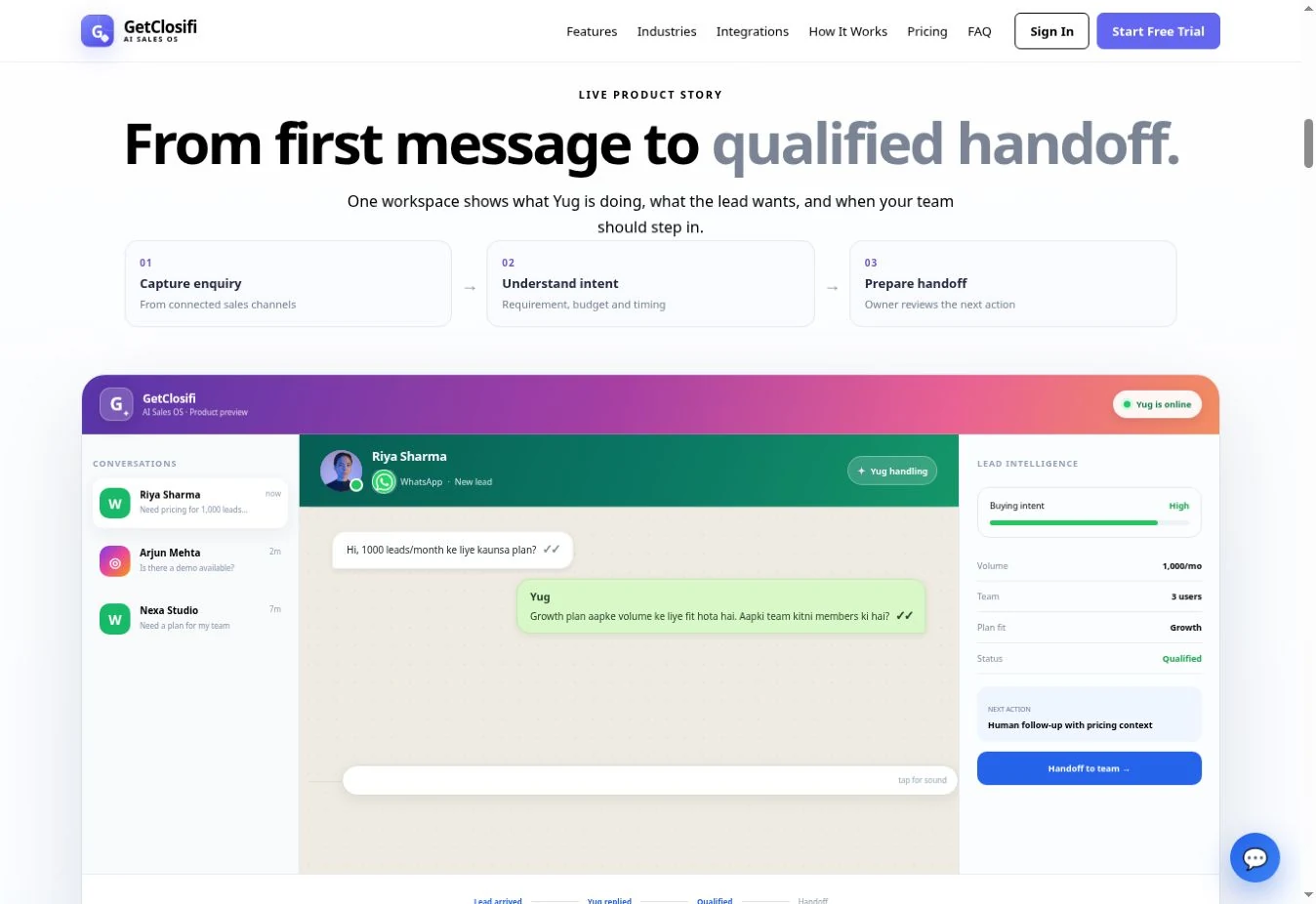
GetClosifi focuses on the enquiry-to-lead stage. Yug, its AI Sales Employee, is designed to understand approved business context, help with responses and qualification and surface structured customer information for human follow-up. Alex Business Copilot provides an owner-facing view of relevant workspace information.
Use case: a WhatsApp property enquiry collects the customer's requirement, area, budget and timeline before a human checks availability and follows up. Consider: each business connects its own authorized channels; onboarding, Meta permissions and plan features determine availability. It is not a substitute for all enterprise CRM or outbound email needs. How Yug supports WhatsApp leads ↗
How to choose your sales automation software
- Find the repeatable bottleneck. Which manual step delays your team: first response, lead assignment, follow-up, data entry or reporting?
- Define where leads arrive. Are they mostly web forms, emails, WhatsApp, Instagram, calls or another channel?
- Choose the system of record. Decide what holds the customer, deal and consent history, and what can trigger approved actions.
- Compare billing units. Seats, contact limits, automation tasks, AI messages and provider charges do not mean the same thing.
- Preserve human approval. Quotes, unusual requests, sensitive information and final business commitments deserve defined escalation rules.
- Measure useful outcomes. Track lead-response time, completeness of qualification, follow-up completion and conversions—not only number of automatic messages.
Sales automation vs CRM vs marketing automation
CRM primarily stores contacts and opportunities. Sales automation handles steps in the selling process. Marketing automation focuses on campaign journeys, segmentation and nurturing. Products often overlap, so identify the workflow you actually need rather than relying on labels alone.
If your immediate budget is zero, compare free CRM software for small businesses. If your business sells through messages, compare WhatsApp automation platforms and Instagram DM automation tools.
Need an AI-assisted inbound sales workflow?
Explore GetClosifi's Yug AI Sales Employee for approved customer conversations, lead qualification and human-ready sales context.
Explore GetClosifi →Realistic examples and success metrics
Example: a property business
A customer sends a message asking whether a certain home is available. The assistant records requirements and identifies questions a human agent must verify. The team receives clearer context, but the software should never promise viewing availability without approved booking data.
Example: a B2B service agency
A new website lead can be enriched with form details, assigned to the right sales manager, given an appropriate first response and added to a follow-up queue. That process requires clear data access and opt-in rules.
Example: a small retailer
Approved product details can answer common catalogue questions. Any discount exception, refund issue or disputed order should go to the right human team member.
Measure median reply time, lead qualification completion, handoff accuracy, customer satisfaction and closed deals over a meaningful time window. Do not treat every automated message as a qualified opportunity.
Sources and comparison methodology
This guide is written by GetClosifi, one of the companies included above. The descriptions are grounded in providers' official product and pricing pages, not fabricated hands-on tests or performance rankings.
Frequently asked questions
What are sales automation tools?
They are software platforms that carry out repeatable sales tasks such as lead capture, pipeline updates, email sequences, routing, follow-up reminders and conversational lead qualification.
Which sales automation tool is best for a small business?
Choose based on your workflow. Zoho CRM and Freshsales have free CRM tiers for small teams, HubSpot supports CRM-centered processes, Zapier connects apps and GetClosifi focuses on inbound messaging conversations.
What is the difference between a CRM and sales automation?
A CRM primarily organizes contacts, companies and deals. Sales automation uses triggers, rules and sometimes AI to take action on events within or across systems. Many CRMs include automation features.
Are there free sales automation tools?
Some tools have limited free CRM or task-automation plans. For example, Zapier offers a free task allowance and Zoho CRM lists a three-user free tier. Advanced sequences and integrations may require paid plans.
Can AI sales automation replace sales representatives?
AI can help interpret enquiries and prepare consistent responses, but humans remain important for complex pricing, negotiation, sensitive requests and final commercial commitments.
What is the first sales process to automate?
Automate one high-volume, low-risk task such as first enquiry routing, capturing lead requirements or overdue follow-up reminders. Test the impact before expanding.